

Expectations for data produced by human resources management have intensified.
Descriptive reporting alone is no longer sufficient in many organizations. Instead, HR analytics is increasingly expected to demonstrate how onboarding and training impact business operations.
For example, training reporting is no longer just about reporting completed trainings or hours logged. HR analytics is now expected to assess the ROI of skills development.
If your organization already uses a learning management system (LMS), it is likely already generating comprehensive data to support HR analytics. If HR’s data-driven management capabilities are still being developed, the HR analytics features of a potential learning environment can influence which tool is ultimately chosen.
In this article, we discuss the importance of the learning environment as a data source and the concrete ways it supports data-driven management.
Why a Learning Environment?
The learning environment has become an established and central component of HR analytics.
It is often the first building block for systematically managing skills. It is used to deliver and administer standardized courses, document learning, and potentially demonstrate formal competencies as part of compliance reporting.
Additionally, the learning environment generates extensive data from various stages of digital learning. This data can be a critical part of both descriptive HR reporting and predictive HR analytics.
Use cases can be found, for example, in the following areas:
Pedagogical analytics. By analyzing learning, instructors are better equipped to understand the learning process and receive feedback on training quality. HR analytics can be used to further develop materials, identify problem cases proactively, and improve engagement in training programs.
Process development. HR analytics can help identify bottlenecks in training or onboarding paths, maintain better situational awareness of completed training for compliance reporting, or keep employee skills profiles up to date.
Reporting to management. HR analytics faces growing expectations to deliver relevant information to leadership as well. Topics such as the ROI of skills development, the current state of competencies, and development needs may interest management, and the learning environment can serve as a key data source for understanding these areas.
What Does LMS Data Contain in Practice?
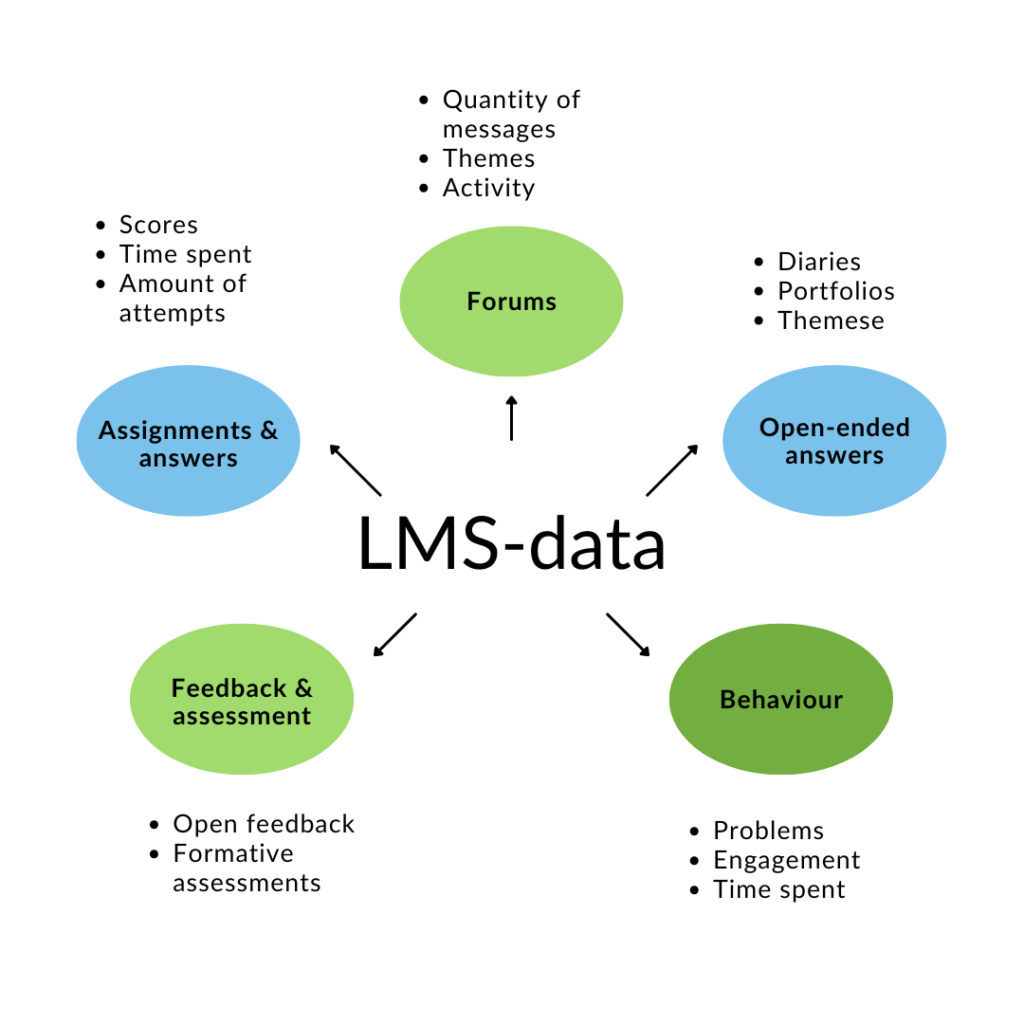
A learning environment can contain a wide variety of data from different learning processes. Data can also exist in different formats: it can be quantitative or qualitative, pertain to individual users or training programs, include text or other file types, and so on.
The environment may contain information related to, for example, the following subjects:
Assignments, quizzes, and exams
The learning environment generates significant data on user performance and progress. HR can easily obtain quantitative and structured data on formal competencies, user activity, and the appeal of materials.
Data can reveal, for example:
- Which trainings have been completed
- Which assignments have been submitted
- Scores received on assignments
- Number of attempts
- Time spent
Forums
The learning platform may include a discussion forum where users can ask questions, support each other’s learning, enable peer-to-peer learning, or discuss course-related topics.
The forum can produce both qualitative and quantitative data that helps understand learners’ interests, specific problems, and user activity. Examples include:
- Number of messages
- Message content, length, and topics
- Common terms and themes
- Activity patterns
Journals, portfolios, and projects
The learning environment can also be used for portfolio pedagogy or various learner-centered activities. Users’ open-ended responses, journal entries, and reflections on their own learning can be excellent sources of qualitative data.
The platform can generate data such as:
- Journal entries
- User-written reflections
- Text topics and themes
- Key terms and terminology
- Timestamps of entries
Signals of learning behavior
Interesting data can emerge from performance and usage patterns that tell more than just which courses were completed and which tasks were finished. They can provide a deeper understanding of learner engagement and, specifically, problem areas within learning materials.
The platform may accumulate quantitative or qualitative data such as:
- How quickly trainings are completed
- Stages of the learning path where progress often slows down
- Which sections are skipped
- Which areas are retried
- Where help is most frequently needed
Assessments and feedback
Not all courses are necessarily fully automated. The learning environment can also support learning through personalized instruction or coordinate blended learning. In such cases, instructors can give feedback or digitally assess their subordinates’ learning.
Instructor activity can also generate interesting data and give HR a better understanding of learning flow. The platform may produce data in areas such as:
- Scores given by instructors
- Open-ended feedback provided by instructors
- Formative assessments by instructors
- How and why data is exported from the learning environment
Exporting Data from the Learning Environment
Learning environments often offer built-in analytics dashboards that can be valuable for individual users or instructors. They can provide, for example, an overall view of a user’s progress or offer instructors an easily compiled picture of their subordinates’ advancement.
However, when data is used for HR analytics or reporting, it is generally more important that data can be exported from the learning environment. There are several reasons for this:
The organization may have other data management tools that better serve its information governance needs (such as data visualization tools like Power BI or Tableau, or various analytics platforms).
Data from the learning environment may need to be combined with data from other sources. This can provide a better overall picture of skills management and enable more comprehensive analytics, not just descriptive reporting.
An external analytics platform can simplify the work of IT governance and reduce the need for training. The fewer different tools the IT team needs to manage, the better.
Data can be exported from the learning environment in several ways. Broadly, the options are:
Data cannot be exported. Either the data cannot be analyzed at all, or users only have access to the learning environment’s own analytics view. This is the worst-case scenario.
Data can be exported as a file, such as .xlsx or .csv formats. This is better than nothing but may create extra manual work.
An API exists for data export. An API enables automation of data export. This is typically the most practical way to integrate learning environment data into the organization’s data management strategy.
Choosing a Tool
The capabilities of learning environments to support HR analytics vary widely. Many learning environments generate valuable data, but practices for storing and exporting it to other systems differ between vendors.
Potential bottlenecks may include cases where data is not stored in the learning environment, it does not meet your organization’s data governance needs, or there are restrictions on exporting the data itself.
If you are acquiring a new learning environment or want to assess the features of your current tool, you can use the following checklist as a memory aid:
- What kind of data does the platform store?
- What export support or API exists for data?
- Does the contract include adequate support for initiating data exports?
- Does the vendor maintain the API and take responsibility for technical issues?
- Is the API documented?
- Are there customer references for data export?
Workseed Data API for HR analytics
The Workseed learning environment is a work-life-oriented learning tool that enables better organization and administration of training. The platform also features a comprehensive Data API that allows you to export learning-related data to other data management tools to support HR analytics.
With the API, you can, for example, export performance-related data or content from the learning platform to external systems.
The Workseed Data API enables:
- Exporting content accumulated in Workseed to other analytics tools
- Integrating data into broader HR analytics and reporting
- Meeting the needs of administration, pedagogical analytics, and management reporting
- Monitoring, comparison, development, and even training chatbots
For example, Oulu University of Applied Sciences has utilized the Workseed Data API to streamline the tracking of internships, theses, and project courses. Through the API, data can be leveraged more broadly in data-driven management and Power BI reporting.
You can explore the customer story here.
If you would like to learn more about the API’s capabilities or try it out yourself, you can book a demo with our experts here.