
Developing competence through blended learning is a functional solution for delivering training and corporate education for many reasons. It adapts to employees’ schedules and makes it possible to tailor learning to the professional needs of individual participants.
At the same time, instructor-led sessions enable better guidance and more effective course engagement than a fully self-paced online course.
In this article, we will explain how to design and implement a functional competence development program through blended learning tailored specifically to your organization’s needs – and how Workseed can make your job easier.
Blended learning is a valuable tool in working life
Blended learning combines traditional classroom teaching and online learning. The term is broad and encompasses a wide variety of practical implementations.
Parts of the studies can be delivered, for example, as face-to-face instruction, or the entire course can be conducted online. The course content can be very precisely predetermined, or students can be given the freedom to choose what and how they study. Courses can also be standardized for large participant numbers or tailored to individual needs.
Blended learning is a popular approach also in corporate training and various coaching programs for many reasons. In particular, the flexibility of studying with regard to learners’ schedules is valuable when it comes to continuing education.
However, blended learning is a valuable way to develop competence for other reasons as well. It enables student-centered teaching easily and cost-effectively, which engages employees better and makes it easier to apply what has been learned in their own work.
Create a foundation for the training by understanding learners’ needs
Designing blended learning begins the same way as designing any other course: by understanding the context. Before a single page is written or an assignment drafted, the course content creator should ask at least the following questions:
Why is the training being created? First, it is necessary to understand what the training aims to achieve. How does it support the organization’s operations and what kind of competence is needed? In order for the resources invested in training to benefit the organization, it is important to understand what is to be achieved at the strategy and competence levels.
For this purpose, the training designer must understand the company’s strategy and map competence gaps so that they can be addressed. HR and training do not operate in silos but engage in dialogue with management and base their decisions on organizational analysis.
You can read more about mapping training needs in our blog here.
For whom is the training being created? The training audience is likely known or easy to determine before materials are even created. Learners’ needs, preferences, and study habits must be taken into account from the very beginning to ensure commitment to the training and that it is completed effectively.
It is worthwhile to map users’ needs already at an early stage through discussions, observation, interviews, and collecting feedback. At best, training content is created and scripted in collaboration with the students.
What resources and constraints does the training have? Already at the planning stage, it is wise to realistically consider how much time and resources are available and what tools will be used to deliver the training. This determines time allocation – how much time and money is spent on producing learning materials, and how much face-to-face teaching and personal guidance can be offered.
The learning environment is a central component whose features should be considered from the very beginning. How much administrative work can be centralized on the platform, what kind of support tools are needed, what types of learning materials can be created, and on what devices studies can be completed – all affect the entire training design.
Design and produce training materials
The design and scripting of blended learning combine elements from both online course and instructor-led content production. Blended learning is a comprehensive term, and within its framework, very different types of training can be implemented. Once you understand the goals and constraints, you can decide what kind of training is best for you to implement.
Pedagogical scripting is more diverse in blended learning, as it maps out various types of content: online assignments, synchronized course modules, and possibly modules tailored to individual students. The content creator must therefore consider how these components work together as a whole.
In blended learning, for example, the following parts of the training might be designed:
Pre-assignments and pre-materials. It is good to give learners the opportunity to familiarize themselves with materials even before the joint sessions begin. This way, everyone can get started at their own pace, and the time used for joint modules is more efficient. Pre-materials can be carefully scripted, or they can include materials that students find themselves. It may also be justified to include assignments that support learning, spark questions, or prepare for exercises conducted during lectures. Learners can also be given opportunities to get to know each other, for example on forums, even before the lectures.
Scripting of joint lectures. If learners have already had a chance to familiarize themselves with the materials in advance, the lectures can be used more efficiently for discussion, group work, or questions. Scripting lectures can therefore be more flexible, but a clear plan should still be prepared in advance.
Exercises, activities, group work. After lectures or between them, learners process the learned topic through various activities. Scripting and planning these is important – even if learners are given a lot of freedom to tailor assignments to their own needs.
Designing and producing learning materials is a multi-stage process that includes planning, pedagogical scripting, creating learning materials, quality testing, and long-term development.
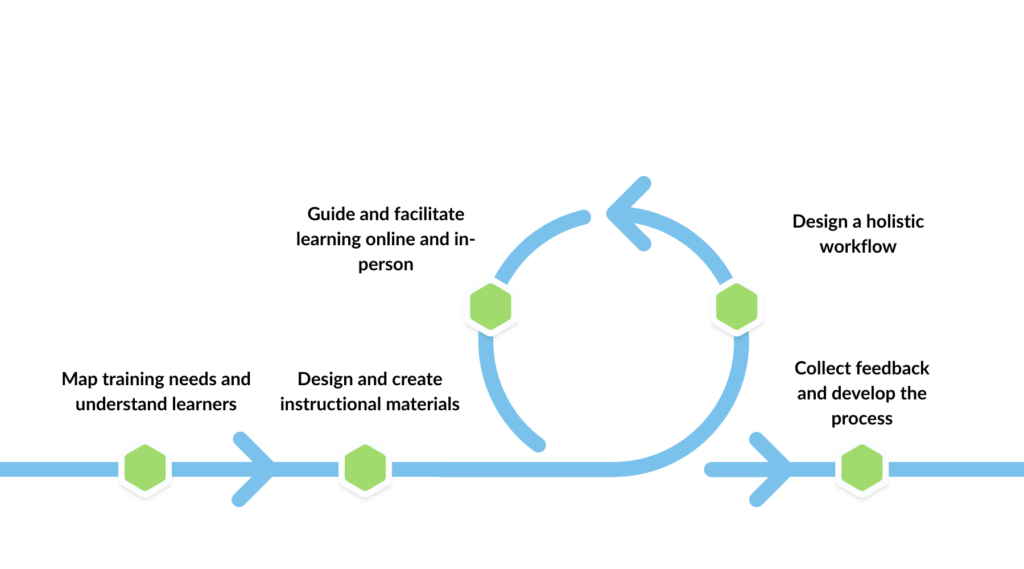
The training workflow
Blended learning differs in many ways from traditional teaching, but it is not purely online studying either. Therefore, designing blended learning differs in its own way from both. For this reason, it is worthwhile to consider how the training will be implemented and how the learning materials will be produced to suit the training.
How are the synchronized studies implemented in practice? Is the training conducted entirely remotely, or does it also include face-to-face instruction? The design of instructor-led modules can vary depending on whether students are in the same space simultaneously. Remote lectures may require special pacing to maintain alertness and improve concentration.
How much opportunity do learners have to decide on their own participation? Blended learning is often flexible in its implementation. Learners can be offered various options to decide on their participation: for example, learners can choose which courses to attend, but also which modules interest them most and even which lectures to join.
How are participants managed? The instructor will likely meet learners from time to time, but much of the logistics happen online. How learners register, how communication and guidance are handled, where questions can be submitted, and how assignments are returned should be defined early on.
The more places the instructor needs to be, the more time teaching takes. Centralizing the management and guidance of studies in one place saves everyone’s time and makes it easier to establish clear rules.
Guide and facilitate
Blended learning is more interactive instruction than taking an online course. Therefore, the workflow for coaching and guidance should be planned as part of the overall training. The instructor’s presence and instructional guidance are important factors that affect learning outcomes, student experience, and commitment to the training.
It is important to create a clear channel for communication and guidance, as well as to set realistic expectations regarding the scope and timing of guidance.
How is feedback given? In addition to synchronized lectures, blended learning often includes communication and interaction also in the online learning environment. This way, learners can receive more individualized and timely feedback than would be possible in a classroom alone.
How are students communicated with? Learners will certainly have questions during their studies. Since in blended learning learners progress at their own pace and from their own starting points, questions can arise at any time. So establish a clear channel for submitting questions.
How is student activity moderated in the group? In online studies, the possibilities of social learning should also be utilized for learner-centered modules. Group work and forums help participants learn from each other and enable scaling of teaching, as the instructor does not need to be everywhere at once. However, moderation of group work should be planned in advance and rules established for it as well.
Develop continuously
A course is never finished at once but develops gradually. Be open to receiving feedback, critically examine parts of the training, identify areas for development, and make iterative changes to the training content, teaching methods, and activities.
Materials can be updated, for example, periodically or even between scheduled deliveries. Development areas can be identified, for instance, as follows:
Collect feedback. There are many opportunities for collecting feedback. Feedback can be collected formally through forms or surveys, and often formal surveys can be conducted directly in the online learning environment. Feedback can also be collected informally through discussions and observation.
Monitor participant activity. Participant activity can indicate development areas and problems in the learning materials. For example, content that takes a long time to complete or is often left unfinished may signal quality issues. Therefore, monitoring student activity can provide valuable data on training quality. Often, monitoring online modules is easy directly in the learning environment.
Develop training collaboratively. The best way to create functional and user-friendly training is to develop it collaboratively. The more you discuss with students, colleagues, and different departments, the better you understand how your training fits the organization’s needs.
Workseed training calendar
Workseed now offers more comprehensive support for managing the entire competence development process through blended learning from start to finish. It is easier for instructors to manage registrations, distribute self-paced assignments, guide based on individual needs, and monitor the progress of all participants – all in one place.
Read here more about the new training calendar.
If you have any questions on the training calendar or want to see it in action, feel free to book a product demonstration with our experts here.